

PROJEKTE
 Quelle: H2ercules/OGE/RWE
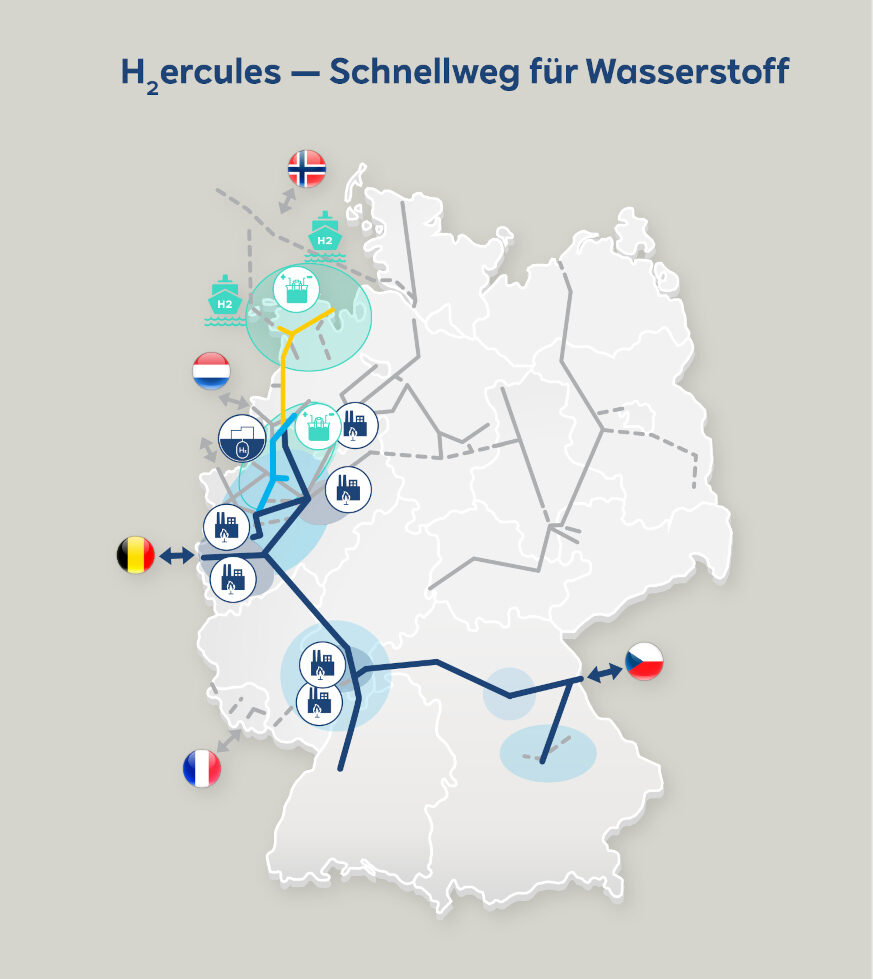
Das geplante Wasserstoffleitungsnetz.
H2ercules
Für den Aufbau der Wasserstoffwirtschaft und die erfolgreiche Umsetzung der Energiewende spielt die Infrastruktur eine maßgebliche Rolle. Im Bereich des Wasserstoffs gilt es daher, ein Wasserstoff-Leitungsnetz aufzubauen, das Orte der Wasserstoff-Herstellung im Norden Deutschlands mit den Industriezentren verknüpft. Um diesen bedeutsamen Prozess zu beschleunigen, haben OGE und RWE das Infrastrukturprojekt „H2ercules“ entwickelt, das Verbraucher im Süden und Westen mit der heimischen Wasserstoffproduktion im Norden verbinden soll. Hierfür sind nicht nur 1.500 Kilometer Leitung, sondern auch bis zu 1 Gigawatt Elektrolyse-Kapazität geplant.
Für den Aufbau des künftigen Wasserstoffnetzes kann ein Großteil des deutschen Erdgasnetzes genutzt werden, da dieses bereits gut ausgebaut ist. Die Umstellung dieser Erdgasleitungen auf Wasserstoff stellt nicht nur die kosteneffizienteste Lösung dar, sondern ermöglicht auch ein schnelles Vorgehen. Allerdings soll das bisherige Gasnetz durch Neubauten ergänzt werden, da es laut der Projektpartner einer strukturellen Neuausrichtung der Gas-Infrastruktur bedarf. Statt von Ost nach West und Süd, muss das Gas, bzw. der Wasserstoff künftig von den Erzeugungsstandorten in Niedersachsen zu den Verbrauchszentren im Westen und Süden fließen. Um dieses Ziel zu erreichen, müssen daher Lücken geschlossen und neue Quellen an das bestehende Leitungsnetz angebunden werden.
Das Projekt wird dabei in zwei Schritten umgesetzt: 2028 soll das Netz von West nach Nord – also vom Ruhrgebiet nach Wilhelmshaven – fertiggestellt werden, bevor 2030 das Netz in den Süden finalisiert wird. Durch diese zeitnahe Umsetzung wollen die Projektpartner die Wasserstoffversorgung der Industrie möglichst zeitnah sicherstellen. Hierdurch soll das bekannte Henne-Ei-Problem durchbrochen werden, da der Industrie der Umstieg auf Wasserstoff durch vorhandene Infrastruktur deutlich erleichtert wird. Die Aufgabenteilung zwischen den Projektpartnern ist dabei klar geregelt: OGE wird die benötigten Leitungen neu errichten, bzw. auf Wasserstoff umstellen und RWE wird eine Elektrolyse-Kapazität von bis zu 1 Gigawatt aufbauen und zudem grünen Wasserstoff importieren.
 Quelle: H2ercules/OGE/RWE
Das geplante Leitungsnetz. © H2ercules
Neben der Elektrolyse-Kapazität und dem Auf- und Umbau der Pipelines sollen im Rahmen des Projekts „H2ercules“ auch Gaskraftwerke mit mindestens 2 Gigawatt und entsprechende Speicher auf Wasserstoff umgerüstet werden. Bestehende Gaskraftwerke und Gasspeicher an der niederländischen Grenze sollen hierzu umgestellt bzw. an das künftige Wasserstoff-Leitungssystem angeschlossen werden. Hierdurch können weitere Backup-Kapazitäten geschaffen werden, die die künftige Energieversorgung sichern.
Das Projekt soll auch zum Aufbau des europäischen Wasserstoffmarktes beitragen. Denn im Rahmen von H2ercules wird Deutschland an wesentliche Importrouten angeschlossen, sei es über Pipelines aus Belgien und den Niederlanden oder auch aus Norwegen.
Projektpartner

Die Open Grid Europe GmbH (OGE) ist ein europäischer Fernleitungsnetzbetreiber mit einem Leitungsnetz von ca. 12.000 km.
Logo: © Open Grid Europe GmbH

RWE beschäftigt weltweit rund 19.000 Mitarbeitende und hat das Ziel, bis 2040 klimaneutral zu werden. Hierzu beitragen sollen auch verschiedene Tätigkeiten im Wasserstoff-Sektor.
Logo: © RWE
Bleiben Sie informiert – mit unserem Newsletter „NWN direkt…“
Sie möchten über diese und andere spannende Wasserstoff-Projekte aus Niedersachsen informiert bleiben? Dann melden Sie sich bei unserem Newsletter an!